
Overview:
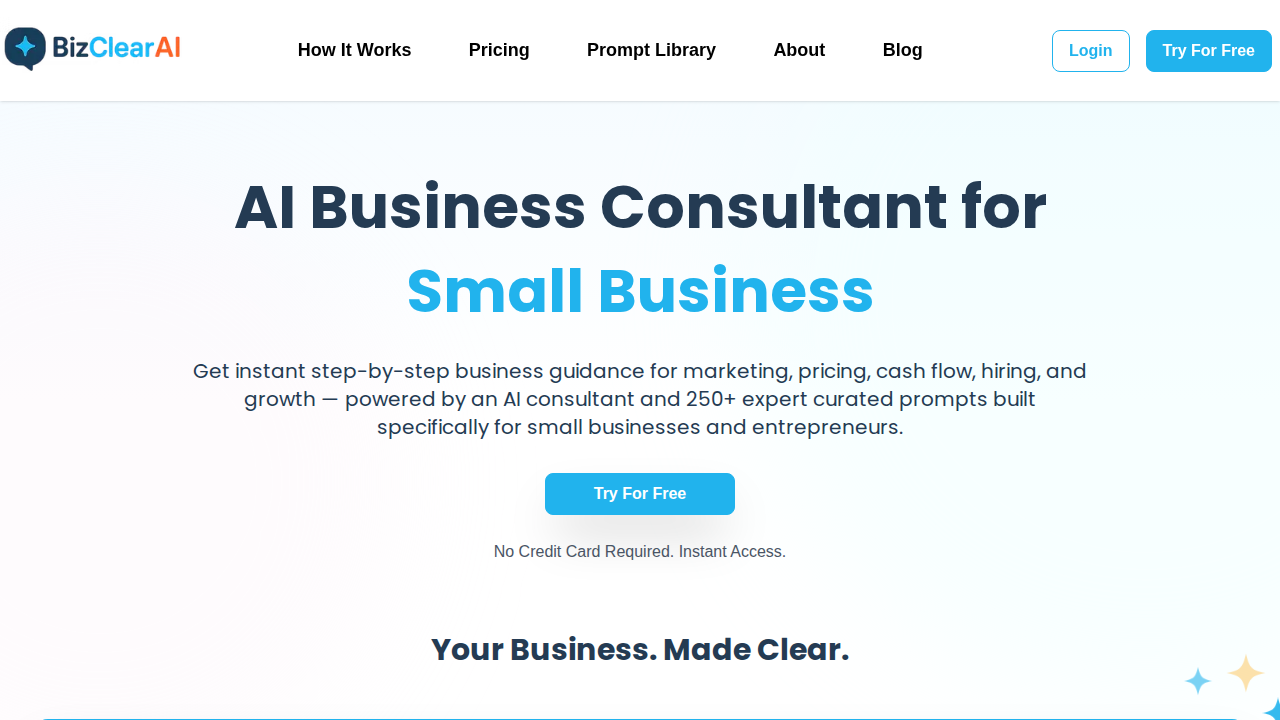
On 05/06/26 bizclearai.com/ scored 48% — **Below Average** – Overall, the site has a solid base, but a few credibility and content clarity gaps are limiting how confidently AI systems can surface it.
Executive summary
Score Breakdown (High Level)
- Discoverability: 100% - This section looks mostly solid, but adding a media-specific sitemap would help search engines better index your site's visual assets.
- Structured Data: 58% - The homepage is doing some heavy lifting with solid Organization and FAQ schema, but we weren't able to confirm any author details or resource-specific markup since that data wasn't available.
- AI Readiness: 67% - The site has a very strong technical foundation for AI engines, though it lacks a Wikidata entry to help anchor the brand's identity.
- Performance: 50% - Mobile performance generally landed outside the 'poor' range for responsiveness and stability, though the initial load time for main content was a bit slow.
- Reputation: 23% - The site has the right social links on the homepage, but it currently lacks the offsite recognition and third-party validation needed to establish a strong brand reputation.
- LLM-Ready Content: 28% - The content is well-structured for humans with descriptive headings, but it lacks critical authority signals like specific authors, dates, and external citations.

The big picture at a glance
What stands out most is that the site generally communicates what it does, but it’s missing several signals that help AI systems trust the brand and confidently reuse the content. The gaps read less like “something is wrong” and more like a few areas where the story isn’t fully supported or consistently validated. Below, we’ll walk through the specific sections where key details were missing or couldn’t be confirmed, so you can see exactly what drove the results. None of this is unusual for growing brands—once these signals are clearer, AI visibility tends to get a lot more predictable.
Detailed Report
Discoverability
❌ Visual content discovery signals missing
What we saw
We didn’t find dedicated discovery support for images or video content. If you publish visual assets, they may not be surfaced as consistently as they could be.
Why this matters for AI SEO
AI answers increasingly pull from mixed media, and clearer signals make it easier for systems to find and reuse your visual assets. When that context is missing, AI may lean more heavily on text-only understanding.
Next step
Add a dedicated discovery feed for your image/video assets so crawlers can find and prioritize that content more reliably.
Structured Data
❌ Resource/blog page markup couldn’t be verified
What we saw
We weren’t able to evaluate any resource/blog page, so we couldn’t confirm whether that content includes the same kind of structured details as the homepage. This leaves a blind spot in how well individual articles can be understood.
Why this matters for AI SEO
When article-level context isn’t clearly described, AI systems have a harder time extracting trustworthy summaries and attributing information properly. That can reduce how confidently your content is used in generated answers.
Next step
Make sure your resource/blog templates include clear structured details that describe each article in a consistent, machine-readable way.
❌ Clear article author details not confirmed
What we saw
Because no resource/blog page was available for review, we couldn’t verify that posts show a clear, non-generic author. That means author credibility signals may be missing or inconsistent.
Why this matters for AI SEO
AI systems look for strong authorship cues to assess expertise and reduce ambiguity about who’s behind the content. When authorship is unclear, trust and attribution can suffer.
Next step
Ensure each article clearly names an individual author in a consistent way that AI systems can recognize.
❌ Author identity references not confirmed
What we saw
We couldn’t verify whether author profiles include identity references that connect the author to established profiles elsewhere. This makes it harder to validate the author as a real, consistent entity.
Why this matters for AI SEO
When author identity isn’t connected to known profiles, AI systems have less to work with when validating expertise and consistency. That can reduce confidence in citing or summarizing the content.
Next step
Add consistent author identity references that tie each author to their official external profiles.
AI Readiness
❌ No Wikidata entity found for the brand
What we saw
We couldn’t find a Wikidata entity associated with the brand. That means there isn’t a strong public “identity anchor” that AI systems can consistently reference.
Why this matters for AI SEO
When a brand lacks a clear identity anchor, AI systems may be less consistent about naming, describing, or confidently recognizing it. This can show up as uncertainty in generated answers.
Next step
Establish a verified Wikidata entry that clearly aligns with your brand’s official identity.
Performance
❌ Main content appears slowly on first load
What we saw
The primary content on the homepage took a bit over five seconds to fully appear. This creates a noticeable delay before the page feels “ready.”
Why this matters for AI SEO
Slower first loads can reduce how consistently pages are accessed and re-checked, especially on mobile connections. It can also affect how easily systems extract content in time-sensitive crawling workflows.
Next step
Reduce the time it takes for the main homepage content to display so the page becomes usable sooner.
Reputation
❌ Negative employee-related claim was flagged
What we saw
The research packet included a negative employee-related assertion about the brand. Even a single negative claim can become “sticky” if it’s not clearly outweighed by stronger, clearer signals.
Why this matters for AI SEO
Generative systems weigh reputation signals when deciding how to frame a brand. Negative assertions can reduce trust and change the tone or confidence of AI summaries.
Next step
Audit the sources contributing to that employee-related claim and build clearer, verifiable signals that reflect the brand accurately.
❌ Brand recognition was inconsistent across AI models
What we saw
Most models did not recognize the brand in a consistent way. This points to limited widespread signals that help AI systems confidently “know who you are.”
Why this matters for AI SEO
If AI systems don’t consistently recognize a brand, it’s harder for them to include it in comparisons, recommendations, and summaries. That can reduce overall visibility in generated answers.
Next step
Strengthen the brand’s presence in credible places that AI systems commonly reference for validation.
❌ Official brand identity details lacked consensus
What we saw
AI models couldn’t reach a consistent understanding of the brand’s official name and physical address. This suggests the identity footprint is either thin or not clearly corroborated.
Why this matters for AI SEO
When identity details are inconsistent, AI systems may hesitate to present the brand as authoritative or may mix details with other entities. Consistency is a big part of trust.
Next step
Align your public-facing identity signals so the brand’s official details are consistent wherever they appear.
❌ No matching Wikidata presence to anchor identity
What we saw
No matching Wikidata entry was found, so there were no Wikidata-based identity anchors available. This removes a key third-party reference point that often helps with disambiguation.
Why this matters for AI SEO
Wikidata is commonly used to connect a brand to verified identifiers and consistent attributes. Without it, AI systems may have a harder time confirming “the official version” of your brand.
Next step
Create and maintain a Wikidata entry that includes the brand’s official identifiers and matches your real-world footprint.
❌ No third-party reviews or verifiable feedback found
What we saw
We didn’t see third-party customer reviews or concrete review sources in the data analyzed. That leaves the brand without widely recognizable external validation.
Why this matters for AI SEO
AI systems tend to trust brands more when there’s independent, verifiable sentiment available. When reviews are absent, the brand may be treated as lower-confidence or less established.
Next step
Build a consistent footprint of verifiable customer feedback on reputable third-party platforms.
❌ No independent coverage or owned press signals found
What we saw
We didn’t find consistent independent press coverage, and we also didn’t see reliable owned/onsite press mentions in the research summary. This makes it harder to corroborate credibility from outside the website.
Why this matters for AI SEO
Press and coverage act as third-party confirmation that a brand is real, active, and notable. Without those signals, AI summaries may stay vague or avoid making stronger claims.
Next step
Develop a trackable history of credible mentions and press-related references that can be independently validated.
❌ Primary social profiles weren’t consistent across models
What we saw
AI models didn’t agree on which social profiles are the brand’s primary ones. That inconsistency can lead to confusion about which accounts are official.
Why this matters for AI SEO
When social identity signals aren’t consistent, AI systems have a harder time connecting brand mentions to the right entity. That can weaken trust and attribution.
Next step
Standardize and reinforce which social profiles are official so they’re consistently recognized across the web.
LLM-Ready Content (Blog Analysis)
Heads up: this section looks at one article as a snapshot, so it’s a little more interpretive than the rest of the report and may shift slightly from run to run. Have questions? Just shoot us an email at hello@v9digital.com
❌ Author isn’t clearly identified
What we saw
No visible author name (and no author detail in structured data) was identified on the evaluated page. As a result, it’s unclear who is responsible for the content.
Why this matters for AI SEO
Authorship is a major trust cue for AI systems trying to judge credibility and expertise. When it’s missing, content can be treated as lower-confidence.
Next step
Add a clear, non-generic author attribution that’s visible on the page and consistently represented in the page’s metadata.
❌ No publish or update date found
What we saw
We didn’t find a publication date or an updated date in the visible content or in the page’s embedded metadata. That makes it hard to tell how current the guidance is.
Why this matters for AI SEO
AI systems often prefer content with clear freshness context, especially for topics that evolve quickly. Missing dates can reduce confidence and limit reuse.
Next step
Add a clear publish date and an update date wherever appropriate so freshness is unambiguous.
❌ Recency couldn’t be confirmed
What we saw
Because no modified or updated date was detected, we couldn’t confirm that the content has been updated recently. This creates uncertainty around whether the page reflects current best practices.
Why this matters for AI SEO
When recency can’t be verified, AI systems may avoid citing the page for time-sensitive questions or summarize it more cautiously. That can reduce visibility in generated answers.
Next step
Make the most recent update date explicit so both users and AI systems can quickly understand freshness.
❌ No non-social external references detected
What we saw
All external links detected were to social platforms, with no links to independent non-social sources. That limits the page’s ability to “show its work” outside of owned channels.
Why this matters for AI SEO
Citations to neutral third-party sources help AI systems validate claims and understand context. Without them, content may be seen as less supported.
Next step
Include at least one relevant non-social external reference that supports or contextualizes key claims on the page.
❌ Sections are too thin (and one block is too long)
What we saw
Although the page is broken into many sections, the average section is quite short, and one area (like the FAQ) can become a single oversized block. This creates an uneven reading and extraction experience.
Why this matters for AI SEO
AI systems do better when content is chunked into consistently sized, self-contained sections that each answer a clear sub-question. Very short sections can feel under-explained, while oversized blocks can be harder to parse.
Next step
Rebalance sections so each one has enough substance to stand alone, without letting any single section become an overly long wall of text.
❌ No table-based structure found
What we saw
We didn’t find any table-based formatting on the page. That removes a useful way to present structured comparisons, steps, or definitions.
Why this matters for AI SEO
Well-structured blocks like tables can make it easier for AI systems to extract precise relationships (like “X vs Y” or “term → definition”). Without them, key details may be harder to reuse cleanly.
Next step
Add a simple table where it naturally fits (for example, comparing options, summarizing steps, or defining terms).
❌ Key answers don’t consistently appear early
What we saw
Only about half of sections lead with enough immediate context to clearly answer the section’s implied question right away. In several places, the “point” arrives a bit late.
Why this matters for AI SEO
AI systems often extract the first clear, complete explanation in a section. If the answer isn’t front-loaded, the system may pull a weaker snippet or miss the intended takeaway.
Next step
Adjust section intros so the first paragraph quickly states the main takeaway in plain language.
❌ Several acronyms aren’t defined nearby
What we saw
Multiple acronyms (including SMB, SOP, SEO, ROI, and TV) appear without nearby definitions. That can make sections harder to interpret for readers and systems that don’t share the same assumptions.
Why this matters for AI SEO
AI systems aim to generate clear, broadly understandable answers. When acronyms aren’t defined, the model may misinterpret meaning or avoid using the content due to ambiguity.
Next step
Define acronyms the first time they appear (or add a short glossary-style callout) so meaning is unambiguous.
Does Anything Seem Off?
Thanks for taking our free GEO Grader for a spin. When we started this journey, the tool had a fairly long processing time to check everything we wanted both onsite and offsite, so we made a few adjustments on the backend to speed things up. As a result, there are times when the grader may not get everything 100% right. If something feels off, we recommend running the tool a second time to confirm the results. From there, you’re always welcome to reach out to us to schedule a GEO consultation, or to have your SEO provider validate the findings with a more detailed crawl and manual review.
