
Overview:
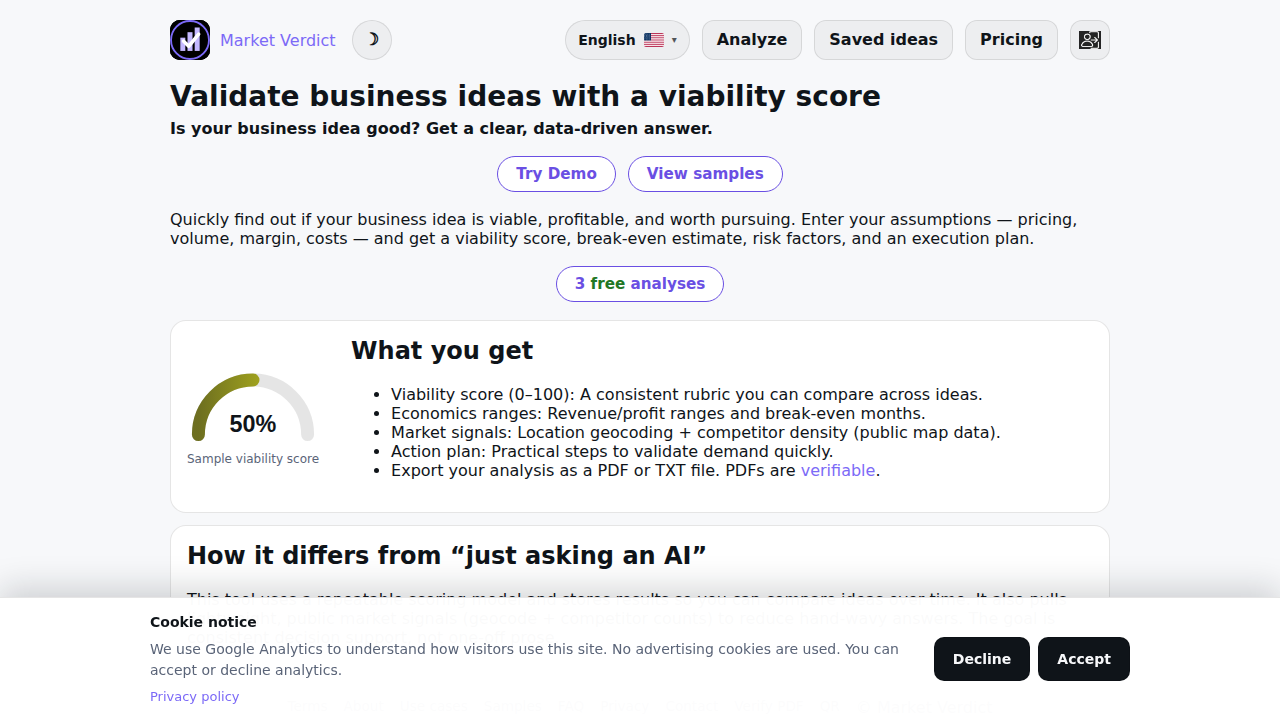
On 06/12/26 marketverdict.app scored 55% — **Fair** – Overall, the foundations are in place, but a few key visibility and trust signals are still too thin to carry the full story.
Executive summary
Score Breakdown (High Level)
- Discoverability: 100% - The site is technically very sound for discovery, though adding an image sitemap would help round out the search footprint.
- Structured Data: 58% - The site has a strong technical foundation with valid organization and software schema on the homepage, though we weren't able to review any blog or resource-specific markup.
- AI Readiness: 67% - The site's technical setup is welcoming to AI crawlers and provides clear brand context, though it currently lacks a Wikidata presence to anchor its brand identity.
- Performance: 67% - The homepage shows strong mobile performance across all measured metrics, including responsiveness and visual stability.
- Reputation: 23% - The site has a clean reputation with no negative feedback, but it currently lacks the offsite signals—like social profiles, press, and reviews—needed to establish strong brand authority.
- LLM-Ready Content: 48% - The page is technically well-structured with clear metadata and recent updates, though the content sections are somewhat brief for comprehensive AI analysis.

Where trust and clarity are thin
The big picture is that the site reads cleanly in some core areas, but it’s missing several of the signals that help AI systems feel confident about who the brand is and why it should be referenced. These gaps mostly show up as visibility and credibility context that isn’t clearly established offsite, plus content that doesn’t give AI many strong “handles” to grab onto. Below, we’ll walk through the specific sections where the report flagged missing pieces so you can see exactly what stood out. None of this is unusual for growing brands, and it’s all very doable once you know what’s being picked up (and what isn’t).
Detailed Report
Discoverability
❌ Missing image or video sitemap
What we saw
We didn’t find a dedicated sitemap for image or video content. That means your visual assets aren’t being explicitly surfaced as their own discoverable set.
Why this matters for AI SEO
When AI-powered search experiences pull results that include visuals, clear signals about what visual content exists can influence whether it’s found and referenced. Without it, some of that content can be easier to overlook.
Next step
Add an image and/or video sitemap and make sure it’s included alongside your existing sitemap setup.
Structured Data
❌ Resource/blog page structured data couldn’t be confirmed
What we saw
A resource or blog page wasn’t provided for review, so we couldn’t confirm whether content pages include the same level of structured clarity as the homepage. This leaves a blind spot around how well deeper content is described.
Why this matters for AI SEO
AI systems tend to rely on consistent, explicit page-level context to understand what a piece of content is and how it should be used. When that’s missing or unknown on content pages, it can reduce how confidently those pages get summarized or cited.
Next step
Share a crawlable resource/blog URL for evaluation and ensure the key content pages include clear structured descriptions.
❌ Blog author clarity couldn’t be verified
What we saw
Because a resource/blog post wasn’t provided, we couldn’t confirm whether posts have a clear, non-generic author. As a result, author attribution on content pages remains unverified.
Why this matters for AI SEO
Clear authorship helps AI systems assess trust and understand “who is speaking,” especially for advice-style or educational content. When author context isn’t clearly established, summaries can become less attributable and less trusted.
Next step
Confirm that each resource/blog post clearly identifies a real author (or a clearly defined editorial owner) in a consistent way.
❌ Author profile connections couldn’t be verified
What we saw
We couldn’t verify whether author profiles include consistent links to known, authoritative profiles because the resource/blog content wasn’t provided. That makes it hard to validate an author’s identity signals.
Why this matters for AI SEO
When AI systems can connect authors to stable identity sources, it’s easier to build confidence in the content and attribute expertise appropriately. Without those connections, content can read as more anonymous.
Next step
Ensure author pages include clear links to the author’s official profiles where appropriate and keep them consistent across content.
AI Readiness
❌ No Wikidata entity ID found for the brand
What we saw
We didn’t see a Wikidata entity ID associated with the brand. This leaves your brand without a common reference point that many knowledge systems use.
Why this matters for AI SEO
AI models often use entity-based identifiers to “connect the dots” across the web and keep brand facts consistent. Without that anchor, identity and brand understanding can be more fragmented.
Next step
Create or claim a Wikidata entry for the brand and align your core brand identifiers to it where relevant.
Reputation
❌ Limited brand recognition across AI models
What we saw
The brand wasn’t consistently recognized across multiple AI model responses. That suggests the brand’s footprint isn’t showing up broadly in the sources models tend to learn from or reference.
Why this matters for AI SEO
When a brand isn’t widely recognized, AI-generated answers are less likely to mention it confidently or include it as a recommended option. Recognition is a big part of whether a brand appears in comparative or “best of” style responses.
Next step
Strengthen and standardize your brand’s offsite presence so the same identity signals show up consistently in places AI systems commonly reference.
❌ Brand identity details weren’t consistently established
What we saw
Key identity fields (like a consistent official name and physical address) were reported as missing or incomplete. That makes the brand profile feel less concrete across sources.
Why this matters for AI SEO
AI systems look for stable identity markers to avoid mixing brands up and to decide what information is reliable. If those markers are inconsistent, your brand can be harder to describe accurately.
Next step
Make sure your core brand identity details are consistently stated across your main web properties and key third-party profiles.
❌ No matching Wikidata entity found
What we saw
No Wikidata entry was identified as matching the brand. That means there isn’t an established public entity record to reinforce official details.
Why this matters for AI SEO
Wikidata is a common backbone for entity understanding across the ecosystem. Without it, it’s harder for AI systems to tie together brand facts in a clean, repeatable way.
Next step
Create a Wikidata entry (or validate an existing one if it exists) so there’s a clear public entity record for the brand.
❌ No official identity anchors from Wikidata
What we saw
Because a Wikidata entry wasn’t found, there were no Wikidata-based identity anchors available (like standardized naming and reference identifiers). This removes a strong external “source of truth.”
Why this matters for AI SEO
Identity anchors help AI systems keep brand info consistent across answers, summaries, and comparisons. Without them, a brand can remain harder to verify.
Next step
Establish a Wikidata record with clear, verifiable identity fields that align with your official brand details.
❌ No third-party reviews or customer feedback found
What we saw
We didn’t see evidence of third-party reviews or customer feedback being picked up in the model-reported data. That leaves a gap in credibility signals coming from outside your own site.
Why this matters for AI SEO
AI systems often lean on outside validation when deciding whether to trust a brand’s claims. Without review signals, your brand can be harder to recommend or rank among alternatives.
Next step
Build a clearer footprint of customer feedback on reputable third-party platforms that can be referenced consistently.
❌ Review sources weren’t identifiable
What we saw
No specific review sources were identified in the available outputs. Even if feedback exists somewhere, it’s not showing up as a concrete, attributable source.
Why this matters for AI SEO
Unnamed or vague review references don’t help AI systems establish confidence. Concrete sources make it easier for AI to cite and summarize sentiment accurately.
Next step
Ensure reviews and testimonials are tied to clearly identifiable third-party sources that are easy to reference.
❌ No clear consensus on major social profiles
What we saw
The model data didn’t show a consistent set of official social profiles tied to the brand. That suggests social identity isn’t clearly established across sources.
Why this matters for AI SEO
Official social profiles can act like identity proof points and help reinforce brand legitimacy. If they’re unclear or inconsistent, AI systems have fewer reliable offsite references.
Next step
Standardize your official social presence so it’s clear which profiles are the canonical ones for the brand.
❌ Homepage doesn’t link to major social profiles
What we saw
We didn’t find links on the homepage pointing to major social platforms. That removes an easy on-site pathway for confirming which profiles are official.
Why this matters for AI SEO
When AI systems and users can’t quickly confirm official brand profiles, trust and entity clarity can suffer. Clear, consistent linking helps reinforce brand authenticity.
Next step
Add clear links from the homepage to the brand’s official social profiles.
❌ No independent press or coverage found
What we saw
No independent press mentions or coverage were identified. That means there aren’t obvious third-party narratives reinforcing what the brand does.
Why this matters for AI SEO
Independent coverage is a strong trust signal because it shows the brand exists beyond its own marketing. Without it, AI systems may have fewer credible sources to draw from.
Next step
Work toward earning and surfacing independent mentions that clearly describe the brand and its offering.
❌ No owned press or news section found
What we saw
We didn’t see an onsite press/news area or press releases being identified in the data. That reduces how much official, time-stamped brand context is available.
Why this matters for AI SEO
Owned announcements can help AI systems understand milestones, product updates, and brand evolution in a structured way. Without them, the brand story can look thinner over time.
Next step
Create an owned press/news section that consistently documents brand updates in a clear, attributable format.
LLM-Ready Content (Blog Analysis)
Heads up: this section looks at one article as a snapshot, so it’s a little more interpretive than the rest of the report and may shift slightly from run to run. Have questions? Just shoot us an email at hello@v9digital.com
❌ No non-social outbound links
What we saw
We didn’t find outbound links to third-party resources or data within the content (outside of social platforms). That makes the page feel more self-contained than it needs to be.
Why this matters for AI SEO
Outbound references help AI systems understand what claims are grounded in external sources and what’s supported by broader context. Without them, the content can be harder to treat as well-supported.
Next step
Add a small set of relevant third-party citations that back up key statements or definitions in the article.
❌ Content isn’t chunked into readable sections
What we saw
The page is split into only a couple of top-level sections, and the sections themselves are very short. This makes the article feel a bit “thin” in terms of scannable structure.
Why this matters for AI SEO
AI systems tend to do better when content is broken into clearly labeled, meaningful chunks that map to distinct questions or subtopics. When sections are too short or too few, it’s harder to extract clean, reusable answers.
Next step
Restructure the article into more clearly defined sections that each cover one complete subtopic with enough detail to stand on its own.
❌ No table used for structured information
What we saw
We didn’t detect any tables used to present structured information. As a result, comparisons or “at-a-glance” takeaways aren’t captured in a format that’s easy to extract.
Why this matters for AI SEO
Tables can make key facts and comparisons easier for AI systems to interpret and reuse accurately. Without them, important details can be buried in paragraphs and harder to summarize cleanly.
Next step
Add a simple table where it naturally fits (for example, summarizing key options, criteria, or outcomes discussed in the article).
❌ Subheadings aren’t descriptive enough
What we saw
Some subheadings were very short or generic, and they didn’t clearly align with the opening sentence of their sections. That makes it harder to tell what each section is really about at a glance.
Why this matters for AI SEO
Descriptive headings help AI systems identify topic boundaries and match sections to specific questions people ask. When headings are vague, the content can be harder to index mentally and reuse accurately.
Next step
Rewrite subheadings so they clearly preview the section’s main idea using concrete, specific language.
Does Anything Seem Off?
Thanks for taking our free GEO Grader for a spin. When we started this journey, the tool had a fairly long processing time to check everything we wanted both onsite and offsite, so we made a few adjustments on the backend to speed things up. As a result, there are times when the grader may not get everything 100% right. If something feels off, we recommend running the tool a second time to confirm the results. From there, you’re always welcome to reach out to us to schedule a GEO consultation, or to have your SEO provider validate the findings with a more detailed crawl and manual review.
