
Detailed Report:
GEO Assessment — the-invisible-economy.jagarfield1.chatgpt.site/
(Score: 74%) — 10/18/26
Overview:
On 10/18/26 the-invisible-economy.jagarfield1.chatgpt.site/ scored 74% — **Good** – Overall, most of the fundamentals are in place, with a few credibility and content-clarity gaps limiting how confidently AI systems can represent the brand.
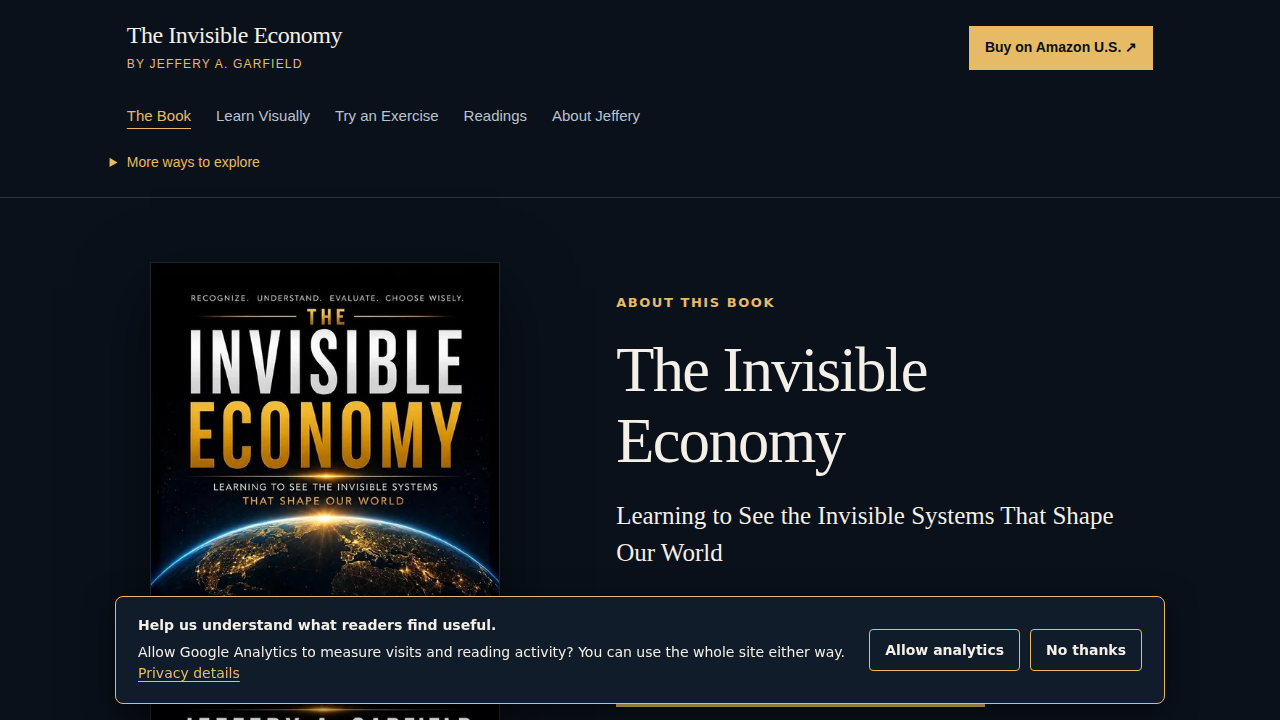
Executive summary
Score Breakdown (High Level)
- Discoverability: 100% - Overall, this section looks to be in good shape with all the core discovery signals like sitemaps and metadata properly configured.
- Structured Data: 100% - Overall, the structured data implementation is excellent, with thorough schema markup for the author, the book, and the organization.
- AI Readiness: 67% - Overall, the site has a solid technical foundation for AI discovery, though it lacks a formal Wikidata entry to anchor its brand identity.
- Performance: 100% - Overall, the mobile performance for both the homepage and resources is excellent and falls well within the healthy range for all key metrics.
- Reputation: 58% - The site demonstrates strong social presence and independent press recognition, but is missing key identity anchors like Wikidata and a verified physical address.
- LLM-Ready Content: 52% - The site demonstrates strong author credibility and content freshness, but its fragmented structure and short section introductions limit its potential for deep AI-driven analysis.

Where clarity and trust fall short
The big picture is that the site comes through clearly in many ways, but a few signals that help AI systems confirm brand identity and credibility are missing or inconsistent, and the resource content can be harder to summarize cleanly. These aren’t “mistakes” so much as moments where the story is a little harder for AI to confidently piece together from what it can see. The next section breaks down the specific areas that didn’t come through strongly, organized by the parts of the evaluation where they showed up. Overall, the gaps are straightforward and common, and this report should give you a clear map of what’s getting in the way.
Detailed Report
AI Readiness
❌ No Wikidata entity found for the brand
What we saw
We didn’t find a Wikidata entity tied to the brand, so there isn’t a clear reference point connecting the site to a recognized knowledge-graph entry.
Why this matters for AI SEO
When AI systems try to understand “who” a brand is, strong identity anchors can reduce confusion and improve consistency in how the brand is described or cited.
Next step
Create and connect a Wikidata entity for the brand so it has a stable, third-party identity reference.
Reputation
❌ Negative client assertions surfaced
What we saw
Offsite brand data included a negative client assertion related to service transparency.
Why this matters for AI SEO
Generative engines tend to be cautious when negative claims show up in the broader brand narrative, which can affect how confidently they recommend or summarize the business.
Next step
Review the offsite sources driving this claim and address the specific transparency concern directly with clear public-facing messaging.
❌ Brand identity lacks a consistent physical address
What we saw
We didn’t see a consistent physical address showing up as part of the brand identity signals.
Why this matters for AI SEO
When key business identity details are missing or inconsistent, AI systems may treat the brand as harder to verify, which can reduce trust and clarity in generated answers.
Next step
Add a consistent physical address wherever the brand’s core identity is presented so it matches across the web.
❌ No Wikidata entity or identity anchors detected
What we saw
No matching Wikidata entity was found, and there were no Wikidata-linked identifiers acting as identity anchors.
Why this matters for AI SEO
Without these anchors, it’s easier for AI systems to mix up entities or treat the brand as less established when assembling summaries and recommendations.
Next step
Establish a Wikidata entry and connect it with relevant identifiers so AI systems have stronger confirmation signals.
❌ No consensus on major social profiles in AI data
What we saw
We didn’t find consensus signals that reliably tie the brand to its major social profiles in the broader AI-understood dataset.
Why this matters for AI SEO
If AI systems can’t confidently associate official profiles with the brand, it can weaken trust and lead to incomplete or inconsistent brand summaries.
Next step
Strengthen the brand-to-profile connections across the web so the official accounts are consistently recognized as authoritative.
❌ No owned press or press releases detected
What we saw
We didn’t see any owned press mentions or press-release style materials reflected in the data.
Why this matters for AI SEO
Owned press can help AI systems quickly understand notable updates, milestones, and positioning in a way that’s easy to cite and summarize.
Next step
Publish an owned press or announcements page (or equivalent) that clearly documents key company updates and milestones.
LLM-Ready Content (Blog Analysis)
Heads up: this section looks at one article as a snapshot, so it’s a little more interpretive than the rest of the report and may shift slightly from run to run. Have questions? Just shoot us an email at hello@v9digital.com
❌ Content sections are too short for easy AI processing
What we saw
The page is broken into many small sections, with the average section landing well below the range typically needed to fully develop a complete thought.
Why this matters for AI SEO
When sections are too thin, generative engines have less context to pull from, which can lead to shallow summaries or missed nuance.
Next step
Combine or expand sections so each main idea has enough depth to stand on its own.
❌ No table-based summary found
What we saw
We didn’t detect a table on the page, so there’s no compact, structured snapshot of key concepts.
Why this matters for AI SEO
Structured summaries can make it easier for AI systems to extract comparisons, definitions, and quick takeaways without guessing.
Next step
Add a simple table that summarizes the main concepts, differences, or frameworks discussed in the article.
❌ Subheadings aren’t consistently descriptive
What we saw
Many subheadings are brief or don’t clearly reflect what their section actually covers, making the outline less informative at a glance.
Why this matters for AI SEO
AI systems lean on headings to map meaning and pull the right passages; vague headings can reduce accuracy when summarizing or quoting.
Next step
Rewrite subheadings so they clearly signal the specific idea each section explains.
❌ Key answers don’t show up early in most sections
What we saw
A majority of sections don’t open with a substantial “answer-first” paragraph, which makes the main point slower to find.
Why this matters for AI SEO
Generative engines often look for quick, self-contained answers near the top of a section to build reliable summaries.
Next step
Adjust section openings so the first paragraph clearly states the takeaway before expanding into supporting detail.
Does Anything Seem Off?
Thanks for taking our free GEO Grader for a spin. When we started this journey, the tool had a fairly long processing time to check everything we wanted both onsite and offsite, so we made a few adjustments on the backend to speed things up. As a result, there are times when the grader may not get everything 100% right. If something feels off, we recommend running the tool a second time to confirm the results. From there, you’re always welcome to reach out to us to schedule a GEO consultation, or to have your SEO provider validate the findings with a more detailed crawl and manual review.
