
Overview:
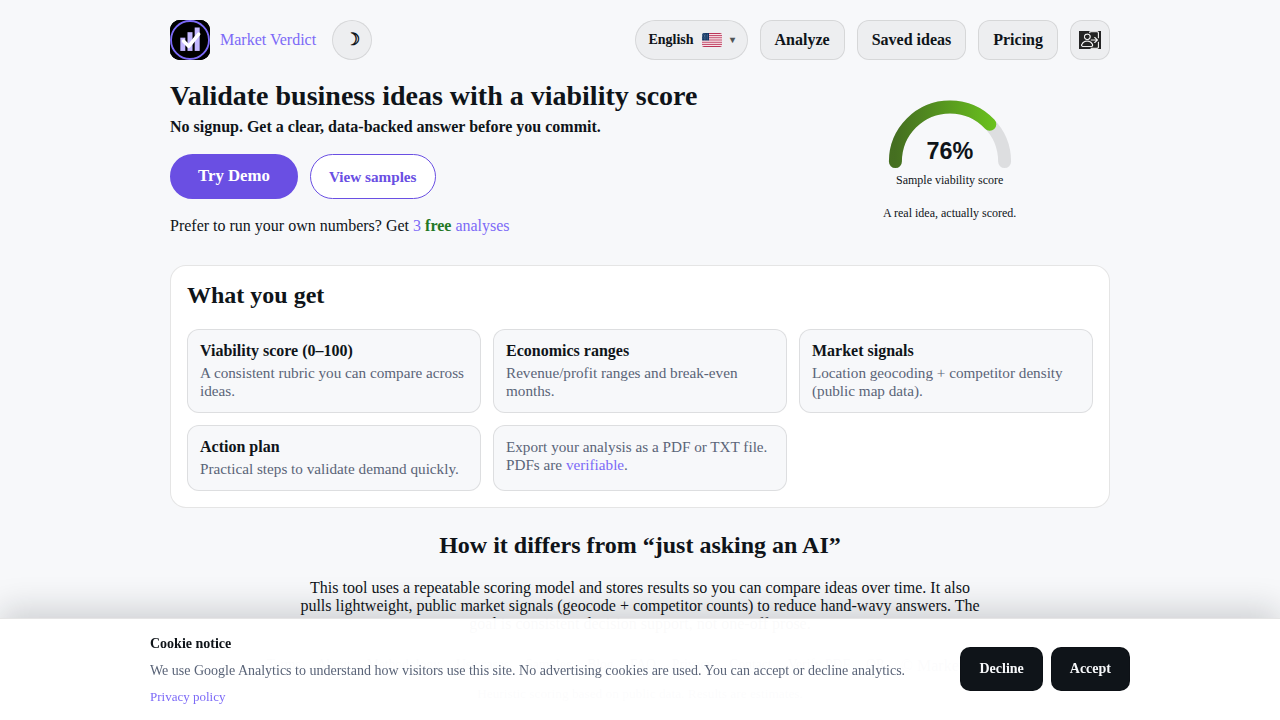
On 06/22/26 marketverdict.app scored 52% — **Fair** – Most of the basics are in place, but the site still feels a bit light on the kinds of content depth and off-site signals that help AI systems confidently describe and recommend you.
Executive summary
Score Breakdown (High Level)
- Discoverability: 100% - The site’s discovery signals are generally solid, though we didn't see an image or video sitemap.
- Structured Data: 58% - The homepage features clean, well-implemented organization and software schema, but we weren't able to confirm author or blog-specific details.
- AI Readiness: 67% - Overall, the site is in great shape for AI discovery with open crawler access and clear sitemaps, though it's currently missing a Wikidata entry to anchor the brand.
- Performance: 67% - Mobile performance for the homepage is in great shape, landing well within the "not poor" range for responsiveness and visual stability.
- Reputation: 35% - The site is starting from a clean slate with no negative marks, but it currently lacks the off-site signals like reviews and social links that help establish broader trust.
- LLM-Ready Content: 24% - The page is technically clean and recently updated, but the content is too brief and lacks the descriptive subheadings needed to effectively signal its value to generative engines.

The big picture before the breakdown
What stands out most is that the site reads as technically steady, but it’s not giving AI systems enough consistent signals around content credibility and real-world brand verification. These gaps don’t necessarily mean anything is “wrong” — they mostly show up as missing context that makes it harder for AI to confidently summarize and recommend you. The sections below walk through the specific areas where those signals were absent or unclear. Once those pieces are in place, the overall story the site tells should become a lot easier for AI to understand and trust.
Detailed Report
Discoverability
❌ Image or video sitemap missing
What we saw
We didn’t find an image sitemap or a video sitemap available for the site.
Why this matters for AI SEO
When media isn’t as clearly mapped out, AI systems can have a harder time discovering and confidently reusing visuals or video context in summaries and recommendations.
Next step
Add a dedicated image sitemap and/or video sitemap so your media content is easier to discover and reference.
Structured Data
❌ Resource/blog page structured data not found
What we saw
We weren’t able to find usable data on the resource/blog page to confirm structured details there.
Why this matters for AI SEO
If AI systems can’t reliably read structured details on content pages, they’re more likely to miss context about what the page is and how it should be interpreted.
Next step
Make sure your resource/blog pages reliably include structured details that describe the page and its content.
❌ Clear author not found on resource/blog content
What we saw
The resource/blog page data wasn’t available to verify an author name, so we couldn’t confirm a clear, non-generic author.
Why this matters for AI SEO
Authorship helps AI systems assess credibility and decide whether a piece of content is safe to quote, summarize, and attribute.
Next step
Ensure each resource/blog post clearly names an author in a way AI systems can consistently recognize.
❌ Author entity links not found
What we saw
We couldn’t confirm any author profile links (like official profile references) tied to the author details on the resource/blog page.
Why this matters for AI SEO
Consistent author identity signals make it easier for AI systems to connect content to a real person and reduce uncertainty around expertise.
Next step
Add consistent author identity references that help connect the author to their recognized profiles.
AI Readiness
❌ Brand Wikidata entity not found
What we saw
We didn’t find a Wikidata item associated with the brand.
Why this matters for AI SEO
A recognized public entity reference can make it easier for AI systems to confidently disambiguate your brand and keep details consistent across answers.
Next step
Create and/or confirm a Wikidata entity for the brand so AI systems have a stronger identity anchor.
Reputation
❌ Verified physical address not identified
What we saw
We didn’t find a verified physical address for the business in the data reviewed.
Why this matters for AI SEO
When location and business identity details are unclear, AI systems may be less confident in describing the organization as established and verifiable.
Next step
Publish a consistent, verifiable business address wherever your official business identity is represented online.
❌ Wikidata presence missing
What we saw
No matching Wikidata entity was identified for the brand.
Why this matters for AI SEO
Without that external identity reference, AI systems have fewer trusted ways to confirm “who” the brand is across the broader web.
Next step
Establish a Wikidata entry for the brand so it can be consistently recognized and verified.
❌ Wikidata anchors not present
What we saw
We didn’t find official identifiers or website links anchored in Wikidata for the brand.
Why this matters for AI SEO
Anchored identifiers help AI systems connect the right brand to the right website and reduce confusion with similar names.
Next step
Add official website and identifier references within the brand’s Wikidata record.
❌ Third-party reviews not confirmed
What we saw
We couldn’t confirm the existence of third-party reviews for the brand.
Why this matters for AI SEO
Independent review signals help AI systems validate real-world usage and make brand mentions feel more trustworthy.
Next step
Build a clear, verifiable presence on reputable third-party review platforms.
❌ Review sources not verified
What we saw
We didn’t identify concrete, verifiable sources that AI systems could consistently point to for reviews.
Why this matters for AI SEO
If review sources aren’t easy to verify, AI systems tend to downplay or omit social proof in summaries.
Next step
Make sure review sources are clearly attributable and easy to validate from recognizable platforms.
❌ Major social profiles not confirmed
What we saw
We didn’t see a clear consensus on the brand’s major social media profiles.
Why this matters for AI SEO
When social profiles aren’t clearly connected, AI systems have fewer independent places to confirm brand activity and legitimacy.
Next step
Make the brand’s primary social profiles easy to find and consistently connected to the official site.
❌ Social links missing from the homepage
What we saw
The homepage didn’t include links out to major social platforms (like LinkedIn, X, or Facebook).
Why this matters for AI SEO
Homepage-linked profiles act like quick identity shortcuts, helping AI systems verify the brand and tie it to the right channels.
Next step
Add prominent links on the homepage to the brand’s official social profiles.
❌ Independent press mentions not identified
What we saw
We didn’t find evidence of independent press coverage or mentions.
Why this matters for AI SEO
Independent coverage is one of the clearest outside validations AI systems use to gauge whether a brand has broader relevance.
Next step
Build a trackable footprint of independent coverage so the brand has verifiable third-party references.
❌ Owned press mentions not identified
What we saw
We didn’t see evidence of owned press releases or mentions.
Why this matters for AI SEO
A consistent brand narrative across official announcements helps AI systems understand what’s new, notable, and accurate.
Next step
Create a dedicated, easy-to-reference place for official announcements that can be consistently discovered.
LLM-Ready Content (Blog Analysis)
Heads up: this section looks at one article as a snapshot, so it’s a little more interpretive than the rest of the report and may shift slightly from run to run. Have questions? Just shoot us an email at hello@v9digital.com
❌ Author name not present
What we saw
No visible author name was found in the body content, and we didn’t find author details included alongside the page’s structured information.
Why this matters for AI SEO
AI systems lean on authorship to judge expertise and decide how confidently they can reuse or attribute the content.
Next step
Add a clear, non-generic author name that is visible on the page and consistently represented.
❌ No non-social outbound link
What we saw
We didn’t find any links going out to external, non-social websites in the content.
Why this matters for AI SEO
Citing or referencing relevant third-party sources can help AI systems treat the content as more grounded and easier to trust.
Next step
Include at least one relevant, non-social external reference where it naturally supports the content.
❌ Content not chunked into substantial sections
What we saw
The page had very limited sectioning, and the sections present were quite short.
Why this matters for AI SEO
When content isn’t broken into meaningful chunks, AI systems have a harder time extracting and summarizing distinct takeaways.
Next step
Expand the page into a few clearly defined sections that each cover a complete idea.
❌ No HTML table detected
What we saw
We didn’t find a table element used anywhere in the article.
Why this matters for AI SEO
Tables can make comparisons and structured facts easier for AI systems to lift accurately without rewriting or guessing.
Next step
Add a simple table where it would help summarize key comparisons, options, or outputs.
❌ Subheadings aren’t descriptive enough
What we saw
Some subheadings were very short or didn’t clearly match what the following section was about.
Why this matters for AI SEO
Clear subheadings help AI systems map what each section covers, which improves summarization and retrieval.
Next step
Rewrite subheadings so they clearly describe the topic of the section in plain language.
❌ Key answers don’t appear early
What we saw
The sections didn’t open with an early, substantial paragraph that clearly sets up the main answer or takeaway.
Why this matters for AI SEO
AI systems often prioritize early text when forming quick summaries, so buried answers can get missed.
Next step
Make sure each main section starts with a short, direct explanation of the key point.
❌ Readability and cohesion issues
What we saw
The content uses multiple acronyms without explaining them in-line, which can make the copy harder to follow.
Why this matters for AI SEO
When terms aren’t explained, AI systems can misinterpret meaning and produce shakier summaries.
Next step
Spell out or define acronyms the first time they appear so the content reads clearly on its own.
Does Anything Seem Off?
Thanks for taking our free GEO Grader for a spin. When we started this journey, the tool had a fairly long processing time to check everything we wanted both onsite and offsite, so we made a few adjustments on the backend to speed things up. As a result, there are times when the grader may not get everything 100% right. If something feels off, we recommend running the tool a second time to confirm the results. From there, you’re always welcome to reach out to us to schedule a GEO consultation, or to have your SEO provider validate the findings with a more detailed crawl and manual review.
