
Overview:
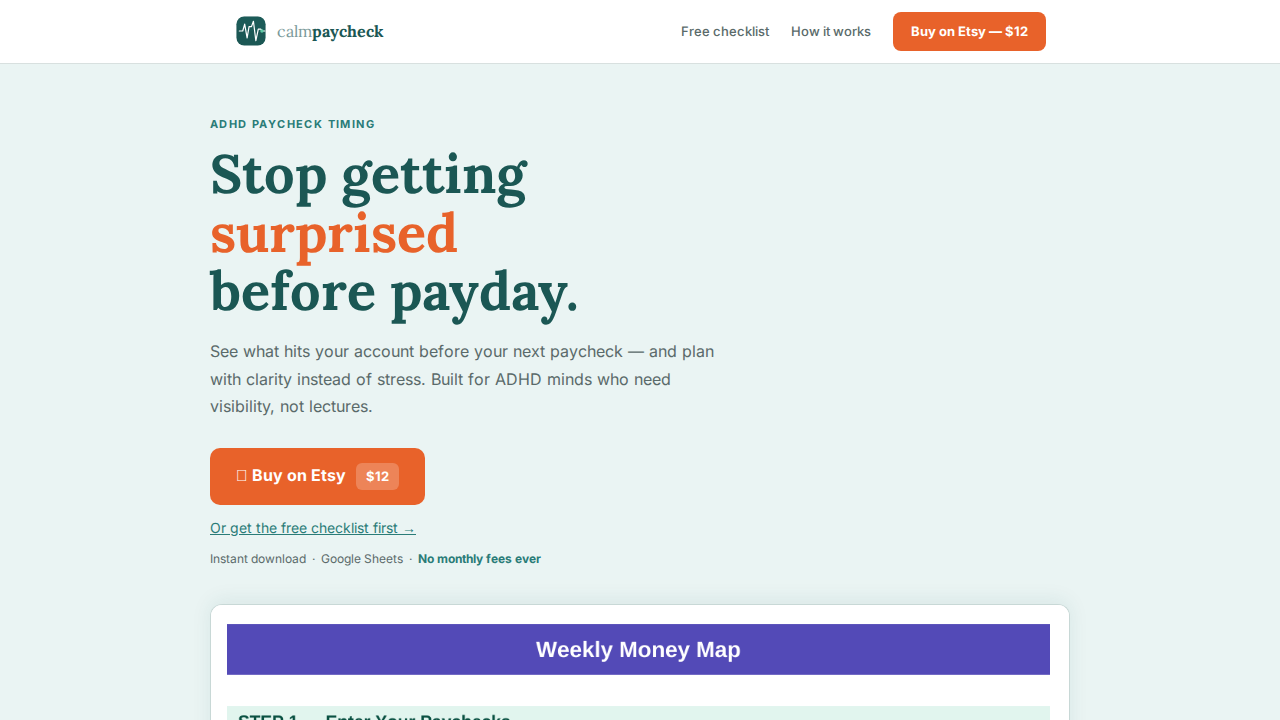
On 07/02/26 calmpaycheck.com scored 46% — **Below Average** – Overall, the basics are there, but the site is missing a lot of the signals that help AI tools confidently understand who you are and why they should trust you.
Executive summary
Score Breakdown (High Level)
- Discoverability: 100% - The site is technically accessible and well-tagged for discovery, but we weren't able to find any XML sitemaps to help search engines map out the content.
- Structured Data: 33% - While the homepage has valid product schema, the site is missing organization-level markup and author verification on resource pages, which limits how well search engines can connect the dots.
- AI Readiness: 17% - We didn't see an XML sitemap or any clear 'About' page links, which are important technical signals for AI discovery.
- Performance: 67% - Mobile performance for the homepage is in great shape, with strong results across responsiveness, visual stability, and loading speed.
- Reputation: 23% - The brand has a clean record with no negative feedback, but it lacks the offsite authority signals like press, reviews, or a Wikidata entry needed to establish strong trust.
- LLM-Ready Content: 56% - The page features excellent descriptive subheadings and clear readability, but it lacks a named author and deeper content sections to help AI systems fully contextualize the information.

What stands out most overall
The big picture is that the site reads as real and usable, but a lot of the signals that help AI systems confidently identify the brand and back it up with outside validation are either missing or hard to confirm. Most of the gaps here are clarity gaps—places where the site doesn’t give engines enough context to connect the dots on identity, credibility, and content ownership. The next sections break down the specific areas where those signals didn’t show up, organized by topic so it’s easy to scan. None of this is unusual for a newer or quieter brand footprint, and it’s all straightforward to address once it’s visible.
Detailed Report
Discoverability
❌ XML sitemap not found
What we saw
We didn’t find a standard sitemap in the usual locations. That means it’s harder to confirm that all important pages are being surfaced cleanly.
Why this matters for AI SEO
Generative engines and search systems rely on strong discovery signals to find and revisit key content. When this is missing, important pages can be easier to miss or take longer to get understood.
Next step
Publish a standard XML sitemap and make sure it’s accessible to crawlers.
❌ Image/video sitemap not found
What we saw
We didn’t detect any image-specific or video-specific sitemap. If media is an important part of the experience, it’s not being clearly summarized for discovery.
Why this matters for AI SEO
AI results increasingly pull from mixed formats, not just web pages. Clear media discovery signals can help your visuals and videos show up more reliably in summaries and recommendations.
Next step
Add a media sitemap (image and/or video) if your site relies on those assets for discovery and understanding.
Structured Data
❌ Brand organization markup missing on the homepage
What we saw
We didn’t find organization-type structured data (like Organization or LocalBusiness) on the homepage. That leaves the brand’s “official identity” less clearly defined.
Why this matters for AI SEO
When AI systems can’t anchor a site to a clear entity, they tend to be less confident about attribution and trust. That can limit how often your brand is named, cited, or summarized accurately.
Next step
Add organization-type structured data that clearly represents the business behind the website.
❌ Resource/blog structured data couldn’t be evaluated
What we saw
A resource/blog page file wasn’t available for review, so we couldn’t confirm whether content pages include the expected structured data. As a result, that part of the site’s trust and clarity signals is effectively unknown here.
Why this matters for AI SEO
Generative engines often learn “who said what” from content pages, not just the homepage. If those pages don’t clearly describe what they are (and who wrote them), it can reduce reuse and reliable summarization.
Next step
Make sure your blog/resource pages are accessible and include structured data that describes the content and its creator.
❌ Blog/resource author couldn’t be confirmed
What we saw
Because the resource/blog page wasn’t available, we couldn’t validate that articles have a clear, non-generic author. That leaves the content’s ownership and accountability unclear.
Why this matters for AI SEO
Author clarity is a common trust shortcut for AI systems deciding what to reference. Without it, content can feel more “anonymous,” which can reduce confidence and citation.
Next step
Ensure each article shows a real author name that’s consistent and easy to identify.
❌ Author identity links not present (sameAs)
What we saw
No author structured data was detected for the resource/blog content, so there were no associated identity links (sameAs) to verify the author across the web.
Why this matters for AI SEO
Identity connections help AI systems reconcile whether an author (or brand) is the same entity across multiple sources. When those connections are missing, trust and attribution can get weaker.
Next step
Add author structured data that includes identity links where appropriate.
AI Readiness
❌ XML sitemap not found
What we saw
We didn’t see a standard XML sitemap available. That makes it harder for AI crawlers to get a complete, organized view of your site.
Why this matters for AI SEO
Generative engines perform better when they can discover content reliably and revisit it over time. A missing sitemap can slow down discovery and reduce coverage.
Next step
Create and publish an XML sitemap that includes your key indexable pages.
❌ Sitemap freshness signals not present (lastmod)
What we saw
We couldn’t confirm any “last updated” markers in the sitemap because the sitemap itself wasn’t found. That means there’s no clear signal of what changed recently.
Why this matters for AI SEO
Recency and update clarity help AI systems prioritize what to re-check and what’s still current. When freshness is unclear, older interpretations can stick around longer.
Next step
Include update timestamps in your sitemap so content changes are easier to understand.
❌ Brand context page not clearly discoverable from the homepage
What we saw
We didn’t detect clear homepage links to an About or Company page. That makes it harder to quickly understand who’s behind the site.
Why this matters for AI SEO
AI systems look for fast, unambiguous brand context to assess credibility and describe a business accurately. When that context is hard to find, the brand narrative can come across as incomplete.
Next step
Make sure there’s an easy-to-find page that explains the brand and is clearly linked from the homepage.
❌ No Wikidata entity found for the brand
What we saw
We didn’t find a Wikidata entry associated with the brand. That leaves a gap in “entity-level” recognition.
Why this matters for AI SEO
Wikidata is one of the places AI systems may use to validate and disambiguate brands. When it’s missing, it can be harder for engines to connect your site to a stable, verified identity.
Next step
Establish a consistent brand entity footprint that AI systems can reliably match to your website.
Reputation
❌ Limited brand recognition across AI models
What we saw
The brand wasn’t consistently recognized across multiple models. That points to a low-confidence footprint in the broader ecosystem.
Why this matters for AI SEO
When recognition is inconsistent, AI answers are more likely to be incomplete or omit the brand entirely. Consistency is a big driver of reliable inclusion.
Next step
Strengthen the brand’s external footprint so it’s easier for AI systems to consistently identify.
❌ Brand identity details not consistently established
What we saw
Brand identity signals didn’t come through consistently, with key details (like a physical address) missing from model responses. That makes the entity feel less grounded.
Why this matters for AI SEO
AI systems lean on stable identity details to validate that a business is real and distinct. Missing core details can reduce trust and lead to vaguer summaries.
Next step
Make sure your core brand identity details are consistently available and easy to confirm.
❌ No matching Wikidata entry detected
What we saw
No Wikidata entry was found that matched the brand. This limits third-party validation signals.
Why this matters for AI SEO
Entity references help AI systems connect the dots between a website and the real-world organization behind it. When those references aren’t there, the brand can be harder to verify.
Next step
Build out a verifiable brand entity presence that can be matched across trusted sources.
❌ No official identity anchors found in Wikidata
What we saw
We didn’t find official identity anchors (like an official website reference) through Wikidata signals. That reduces “authoritative linking” back to your domain.
Why this matters for AI SEO
Official anchors are one way AI systems confirm which site is the canonical source for a brand. Without them, engines may be less certain about attribution.
Next step
Ensure the brand has strong, consistent identity anchors that point back to the official domain.
❌ No third-party reviews or customer feedback detected
What we saw
We didn’t see evidence of third-party reviews or customer feedback. That leaves a gap in public-facing validation.
Why this matters for AI SEO
AI systems often look for independent signals that real customers have interacted with a brand. When that’s missing, credibility can be harder to establish in summaries.
Next step
Establish a review footprint on reputable third-party platforms that clearly ties back to the brand.
❌ Review sources weren’t concrete
What we saw
No concrete review sources were surfaced. That means even if sentiment exists somewhere, it’s not clearly attributable.
Why this matters for AI SEO
AI engines tend to trust named, verifiable sources more than vague references. If sources aren’t clear, reviews are less likely to be used in generated answers.
Next step
Make sure review signals are tied to specific, reputable sources that can be cited.
❌ No consistent set of social profiles identified
What we saw
There wasn’t a clear consensus on the brand’s major social profiles. This makes it harder to confirm which accounts are official.
Why this matters for AI SEO
Official social profiles are common trust and identity signals. When they’re unclear, AI systems may avoid referencing them or may misattribute the brand.
Next step
Standardize and clearly associate official social profiles with the brand identity.
❌ Homepage doesn’t link to major social profiles
What we saw
We didn’t find links from the homepage to major social platforms. That makes it harder to confirm official accounts directly from the site.
Why this matters for AI SEO
Direct links are a straightforward way for AI systems to validate identity and relationships. Without them, brand verification can be less confident.
Next step
Add clear homepage links to official social profiles where they exist.
❌ No independent press or coverage detected
What we saw
We didn’t see signs of independent, offsite coverage of the brand. That suggests the brand has a limited external visibility footprint.
Why this matters for AI SEO
Independent mentions help AI systems triangulate legitimacy and relevance. Without them, the brand can feel harder to validate beyond its own site.
Next step
Build a set of independent references that clearly mention the brand and align with its identity.
❌ No onsite press or press releases detected
What we saw
We didn’t find onsite press coverage or press releases. That limits the amount of brand storytelling and milestone context available on your own domain.
Why this matters for AI SEO
AI systems pull brand facts from multiple places, and owned announcements can help clarify timelines, offerings, and credibility. If this layer is missing, the brand narrative can be thinner.
Next step
Create a dedicated place on the site for brand announcements or press-style updates.
LLM-Ready Content (Blog Analysis)
Heads up: this section looks at one article as a snapshot, so it’s a little more interpretive than the rest of the report and may shift slightly from run to run. Have questions? Just shoot us an email at hello@v9digital.com
❌ No named author identified
What we saw
We didn’t see a clear, non-generic author name associated with the article. From a trust standpoint, it reads more like anonymous content.
Why this matters for AI SEO
AI systems tend to trust and reuse content more confidently when they can attribute it to a real person or clearly defined source. Missing authorship can reduce how often the content is cited or summarized.
Next step
Add a visible author name to the article and make it consistent wherever the content appears.
❌ Recency isn’t clearly confirmed
What we saw
While a site-wide year appears in the footer, there wasn’t an explicit “updated” or “modified” date on the article to confirm it’s been refreshed recently.
Why this matters for AI SEO
If recency isn’t clear, AI summaries may treat the content as potentially outdated or be less likely to prioritize it for time-sensitive answers.
Next step
Add a clear “last updated” date on the article when meaningful changes are made.
❌ Sections are too thin for easy summarization
What we saw
The page uses headings, but the sections themselves are short and light. That creates a lot of structure without enough substance inside each part.
Why this matters for AI SEO
LLMs do best when each section contains enough detail to stand on its own during chunking and summarization. Thin sections can lead to shallow or incomplete takeaways.
Next step
Expand key sections so each one provides a fuller explanation that can be summarized on its own.
❌ No table detected (bonus)
What we saw
We didn’t detect a table-based layout for any quick comparisons or summaries. The content is mostly presented in standard paragraph form.
Why this matters for AI SEO
Tables can make structured takeaways (like comparisons, steps, or checklists) easier for AI systems to interpret and reuse accurately.
Next step
Where it fits naturally, add a simple table to summarize the key options, steps, or comparisons in the article.
Does Anything Seem Off?
Thanks for taking our free GEO Grader for a spin. When we started this journey, the tool had a fairly long processing time to check everything we wanted both onsite and offsite, so we made a few adjustments on the backend to speed things up. As a result, there are times when the grader may not get everything 100% right. If something feels off, we recommend running the tool a second time to confirm the results. From there, you’re always welcome to reach out to us to schedule a GEO consultation, or to have your SEO provider validate the findings with a more detailed crawl and manual review.
