
Overview:
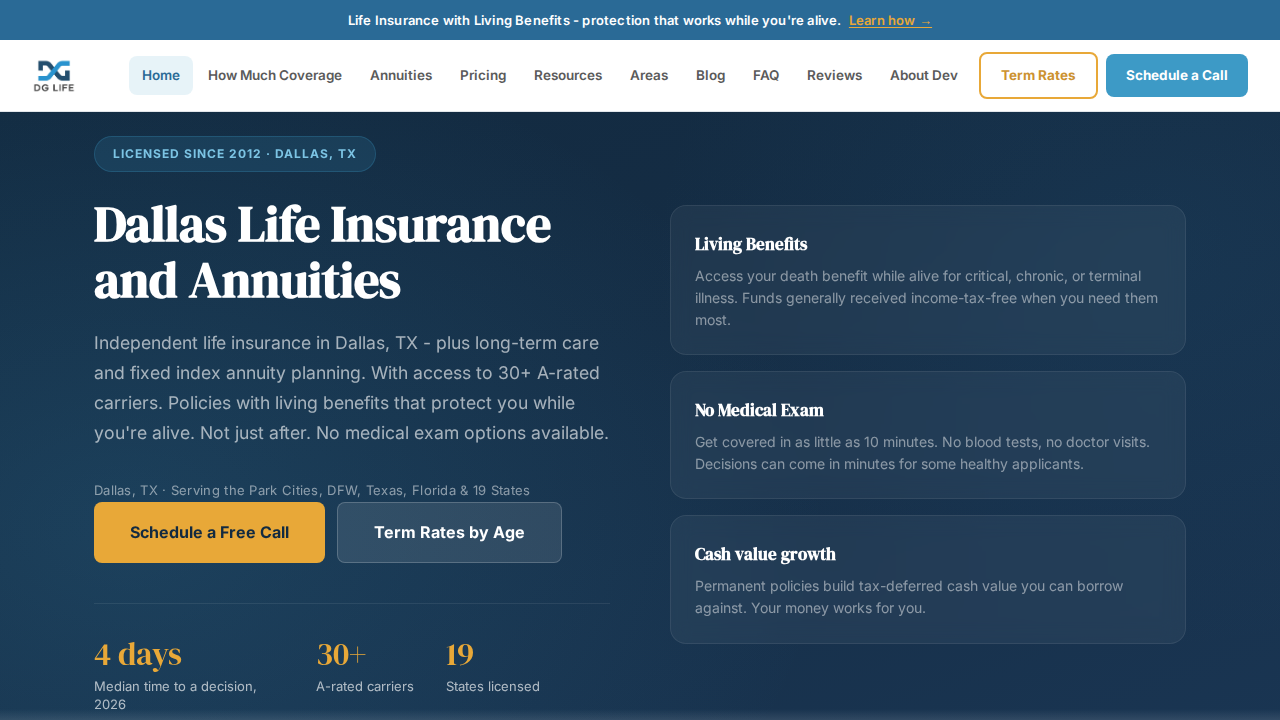
On 10/08/26 dglifegroup.com scored 68% — **Decent** – overall, this site shows a solid foundation for AI visibility, with a few clarity and consistency gaps that make it harder for systems to confidently interpret everything.
Executive summary
Score Breakdown (High Level)
- Discoverability: 100% - The site is wide open to search and AI crawlers with solid metadata, though it's missing a specific sitemap for images or video.
- Structured Data: 58% - Overall, the homepage schema is expertly handled with detailed organization and FAQ data, though we couldn't confirm authorship or article schema due to missing resource page data.
- AI Readiness: 67% - The site has a strong technical foundation for AI with open crawler access and updated sitemaps, though it lacks a Wikidata entry for enhanced brand recognition.
- Performance: 50% - Mobile performance is mostly solid with good responsiveness and stability, but the initial page load time is currently lagging behind Google's recommended thresholds.
- Reputation: 81% - The brand shows strong recognition and positive sentiment across AI models, though conflicting address data and a missing Wikidata entry currently prevent a perfect reputation score.
- LLM-Ready Content: 60% - The page establishes great trust through clear author expertise and recent updates, though the subheading structure and long FAQ block could be tightened up for better AI extraction.

What stands out most overall
The big picture is that the site shows strong baseline visibility signals, but a few key areas are coming through a little fuzzy for AI systems. Most of the gaps aren’t “bad” so much as missing context or inconsistent identity cues that make it harder to confidently interpret and reuse what you’ve published. The next section breaks down the specific places where that clarity dropped off, grouped by the same categories you were evaluated on. Overall, this is a manageable set of issues—and the detailed notes below will make it clear what was and wasn’t showing up.
Detailed Report
Discoverability
❌ Missing image or video sitemap
What we saw
We didn’t find an image sitemap or a video sitemap available for the site. This leaves visual content with less explicit support for being discovered and categorized.
Why this matters for AI SEO
AI-driven search experiences often rely on clear, comprehensive discovery signals to understand what content exists and what it’s about. When visual content is harder to enumerate, it can be less likely to surface in rich answers and AI summaries.
Next step
Add a dedicated image and/or video sitemap so engines can more reliably discover and interpret your visual assets.
Structured Data
❌ Blog/resource structured data couldn’t be verified
What we saw
We weren’t able to validate structured details for a resource or blog page because the resource page file provided was missing or empty. As a result, this part of the site couldn’t be assessed in the same way as the homepage.
Why this matters for AI SEO
When article-level information can’t be confirmed, AI systems have less consistent context for understanding and confidently citing specific pieces of content. That can reduce how often individual articles show up as attributable sources.
Next step
Provide an accessible, crawlable resource/blog page so article-level structured details can be detected and understood.
❌ Clear author information wasn’t confirmable for a resource post
What we saw
No resource page was available to identify and verify whether posts consistently show a clear, non-generic author. That means author clarity couldn’t be confirmed at the content level.
Why this matters for AI SEO
AI systems look for reliable attribution when deciding what to trust and reuse. If author information isn’t consistently visible and verifiable on content pages, it can weaken how confidently content is referenced.
Next step
Ensure each resource/blog post clearly displays a specific author identity that can be consistently validated.
❌ Author “sameAs” profile links weren’t evaluable
What we saw
Because author-specific data couldn’t be evaluated on a resource page, we also couldn’t confirm whether author profiles include consistent “sameAs” links to recognized identity profiles.
Why this matters for AI SEO
When AI systems can’t connect an author to consistent identity references, it’s harder to build confidence that the same person is behind the content across the web. That can limit how strongly authorship contributes to trust.
Next step
Add consistent identity profile links for authors so their presence can be corroborated across the web.
AI Readiness
❌ No Wikidata entity found for the brand
What we saw
We didn’t find a Wikidata entity associated with the brand. The brand data did not include a Wikidata item reference.
Why this matters for AI SEO
Wikidata is a common reference point for how AI systems disambiguate and verify real-world entities. Without it, it can be harder for models to confidently treat the brand as a distinct, verified entity.
Next step
Create and/or connect a Wikidata entity for the brand so AI systems have a stable reference for verification.
Performance
❌ Homepage primary content loaded slowly
What we saw
The homepage’s main visible content took longer than expected to appear, with the largest on-page element arriving after about 6 seconds. This points to a slower initial loading experience.
Why this matters for AI SEO
When key content is slower to load, it can reduce the consistency of how quickly engines and AI experiences can access and interpret what the page is about. Over time, that can make the page less competitive as a reliable source.
Next step
Improve the homepage’s time-to-visible primary content so key information appears more quickly and consistently.
Reputation
❌ Brand identity signals conflict on physical location
What we saw
We saw an identity conflict around the brand’s physical address, with different models reporting locations in Smyrna, GA and Fort Lauderdale, FL. This creates ambiguity around the brand’s canonical identity.
Why this matters for AI SEO
When key identity details conflict, AI systems can hesitate to unify mentions into a single entity with confidence. That friction can weaken visibility in situations where strong entity verification matters.
Next step
Align the brand’s canonical address references so major sources and AI-visible profiles point to one consistent location.
❌ No matching Wikidata entry for the brand
What we saw
No matching Wikidata entry was found for the brand in the reputation checks. This mirrors the brand-entity gap noted elsewhere in the report.
Why this matters for AI SEO
Without a recognized entity record, it’s harder for AI systems to anchor the brand to a stable identity graph. That can reduce confidence when models summarize, recommend, or cite the business.
Next step
Establish a Wikidata entry for the brand so there’s a consistent entity anchor AI systems can reference.
❌ Wikidata identity anchors couldn’t be present
What we saw
Because no Wikidata entity was identified, there was nothing available to evaluate for official identity anchors. This criterion failed due to the missing entity itself.
Why this matters for AI SEO
Identity anchors help AI systems connect a brand to verified references and reduce confusion with similarly named entities. Without them, entity confidence can remain lower than it needs to be.
Next step
Once a Wikidata entity exists, ensure it includes clear official identity anchors that match the brand.
LLM-Ready Content (Blog Analysis)
Heads up: this section looks at one article as a snapshot, so it’s a little more interpretive than the rest of the report and may shift slightly from run to run. Have questions? Just shoot us an email at hello@v9digital.com
❌ Content wasn’t broken into AI-friendly sections
What we saw
A large FAQ block sits under a single heading at roughly 550 words, which is a lot for AI systems to digest as one unit. At the same time, the average section length was on the short side, making the overall structure feel uneven.
Why this matters for AI SEO
AI systems do better when information is packaged into clear, self-contained chunks that can be lifted into answers without losing context. Oversized blocks and uneven sectioning can make it harder to extract clean, reliable snippets.
Next step
Restructure the content so major topics are split into more evenly sized, clearly separated sections.
❌ No table found to support quick scanning
What we saw
We didn’t see a table used in the visible content. That means readers (and AI systems) don’t get an easy “at-a-glance” format for comparisons or summaries.
Why this matters for AI SEO
Structured, scannable formatting can make it easier for AI to accurately restate details without missing nuance. Without it, key distinctions may be harder to interpret and reuse.
Next step
Add a simple comparison or summary table where it naturally fits to make key information easier to extract.
❌ Subheadings didn’t consistently match section openings
What we saw
Many subheadings didn’t share meaningful wording with the first sentence of the section they introduce. This makes some sections feel less tightly “labeled” than they could be.
Why this matters for AI SEO
AI systems often use headings as a shortcut to confirm what a section is about. If headings and section openings don’t line up, relevance can be harder to verify.
Next step
Tighten alignment between each subheading and the first sentence that follows so the topic is immediately clear.
❌ Key answers weren’t consistently surfaced early
What we saw
A meaningful share of sections didn’t start with a substantial opening paragraph, so the “main point” often arrives a bit later. That can make sections slower to interpret at a glance.
Why this matters for AI SEO
AI summaries tend to prioritize early, definitive statements in each section. When key answers don’t appear upfront, the system may miss the best takeaway or choose a less representative snippet.
Next step
Rework section introductions so the first paragraph quickly states the core answer or takeaway.
Does Anything Seem Off?
Thanks for taking our free GEO Grader for a spin. When we started this journey, the tool had a fairly long processing time to check everything we wanted both onsite and offsite, so we made a few adjustments on the backend to speed things up. As a result, there are times when the grader may not get everything 100% right. If something feels off, we recommend running the tool a second time to confirm the results. From there, you’re always welcome to reach out to us to schedule a GEO consultation, or to have your SEO provider validate the findings with a more detailed crawl and manual review.
